
Near-Earth Object Hazard Prediction
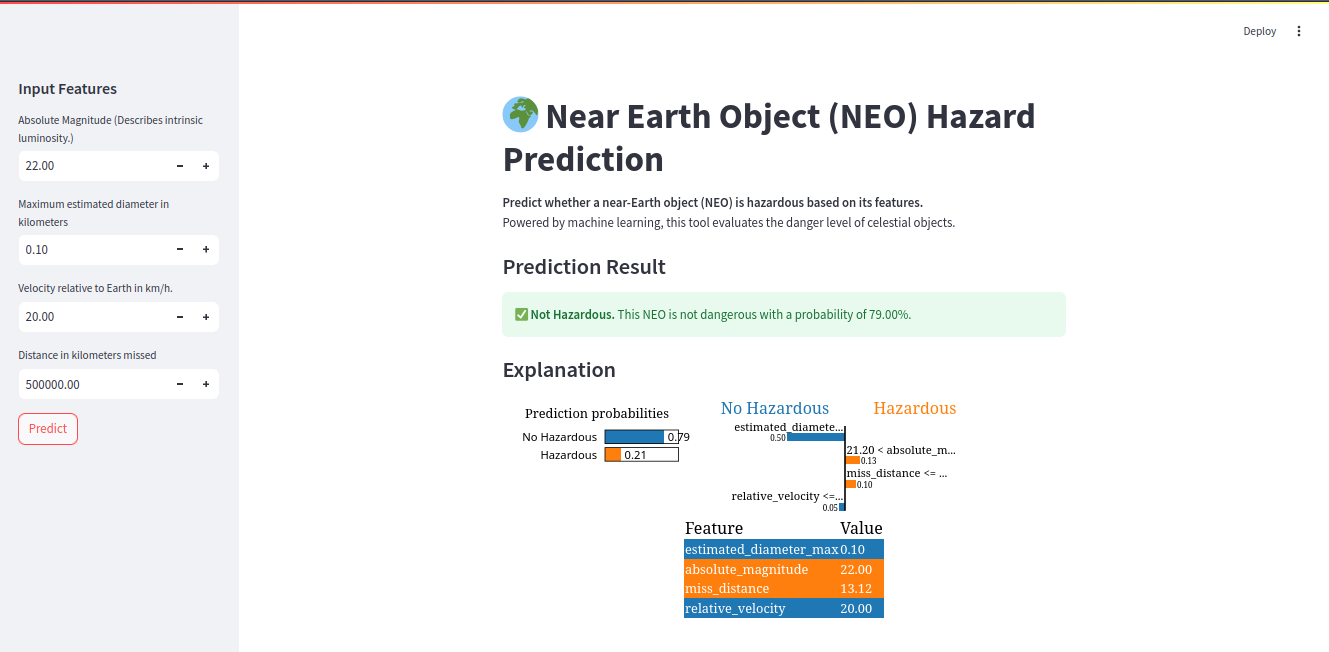
This project predicts whether a Near-Earth Object (NEO) is potentially hazardous using machine learning. Trained on NEO observations recorded between 1910 and 2024, the model classifies objects as hazardous or non-hazardous, supporting NEO risk assessment.
Highlights
- Full workflow: data cleaning, exploratory data analysis, handling class imbalance, model training, and evaluation, with PyCaret and Scikit-learn.
- A Random Forest classifier achieved the best accuracy among the models tested.
- Explainable predictions with LIME, highlighting key features such as absolute magnitude, estimated diameter, relative velocity, and miss distance.
- Model serialized with Skops and served through an interactive Streamlit app (also runnable with Docker).
Tech stack: Python · Pandas · Scikit-learn · PyCaret · LIME · Skops · Streamlit